
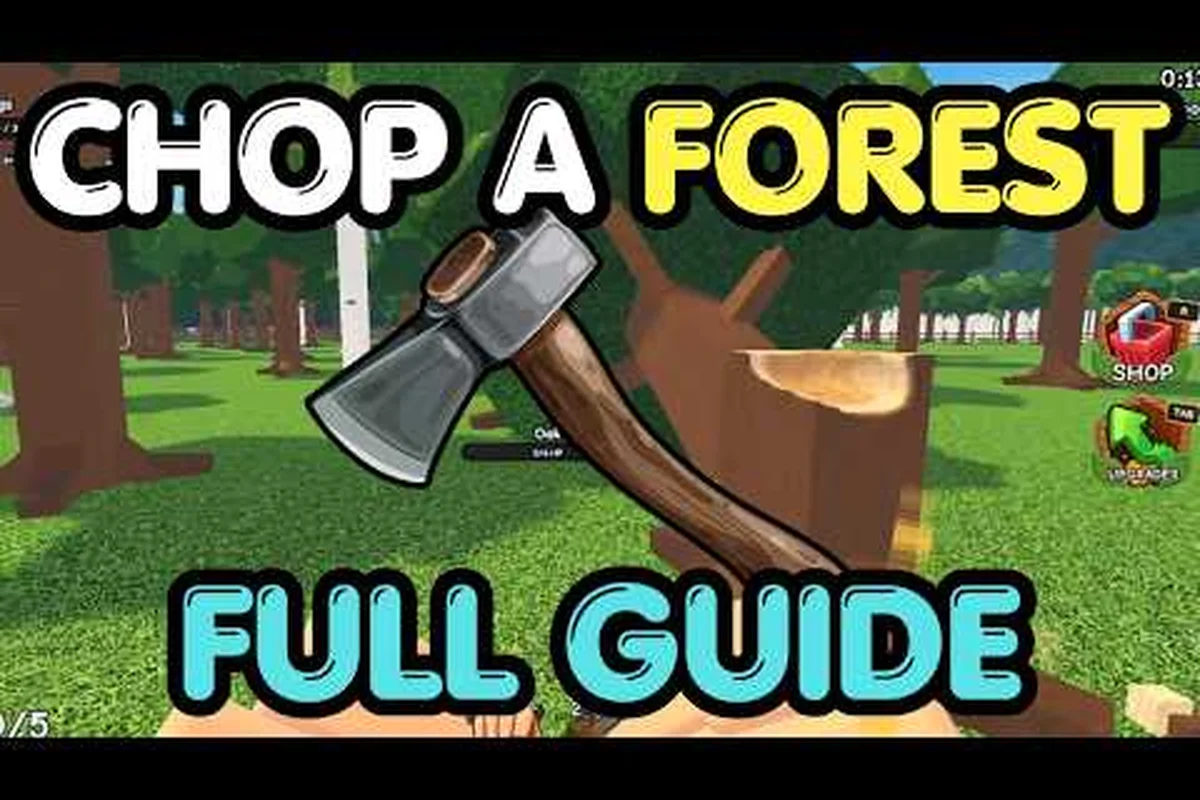
You spawn in front of the sawmill with nothing but bare fists and a patch of trees. That is the entire opening pitch of Chop A Forest, and it is also the reason this chop a forest full guide exists — because the first hour decides whether you are grinding the same loop for a week or unlocking the Big Bag endgame in a single afternoon. Knowing which upgrades to buy, when to grab a class, and how to chain runs with friends turns the chop a forest coin farming guide from a slog into a smooth factory line of logs and Coins.
Your First Hour: Punching Trees and the 150-Coin Axe
The opening loop in Chop A Forest is intentionally short so that new players can taste progress within minutes. You stand in front of the sawmill, walk up to a tree, and punch it. Each hit converts a standing trunk into a stack of logs lying on the ground, and pressing E picks up several at once so you can carry them back to the mill. According to the the game page on the Roblox store, selling those logs at the sawmill is the only way to start earning Coins, which means the speed of your very first chopping directly controls how fast you can afford your first real upgrade.
Why the First 150 Coins Matter
The single most important purchase in any Chop A Forest money making guide is the Axe, which costs exactly 150 Coins. Every Chop A Forest beginner route prioritizes this tool because it multiplies the logs you get per swing and shortens the time it takes to fell a tree. Without the Axe, you are still functionally playing the game, but you are also earning roughly one-third the Coins per minute that an Axe-equipped player earns. Community data reported by the ProGameGuides beginner walkthrough consistently highlights the Axe as the foundation of every profitable loop.
| First-Hour Milestone | Coins Needed | What Unlocks | Why It Matters |
|---|---|---|---|
| Punch a tree, sell logs | 0 | First sale at the sawmill | Teaches the core loop |
| Buy the Axe | 150 | First tool upgrade | Multiplies logs per swing |
| Stack grasp upgrade | 300 | Carry more logs per trip | Fewer sawmill runs per tree |
| Walk-speed upgrade | 500 | Faster travel between trees and mill | Less downtime carrying |
| Radius upgrade | 800 | Hit several trees at once | Higher output per minute |
Building the Pre-Axe Habit
Before you even hit 150 Coins, the way you chop sets the tempo for the rest of the run. Stand as close to a tree as possible to minimize the gap between swings, hold E the moment logs drop so you never leave free wood on the ground, and sell in small but frequent batches because partial loads still count. Players who try to carry five trips' worth of logs before walking back usually lose more wood to dropped pickups than they save in travel. The opening hour is less about pushing hard and more about building muscle memory for the loop, which is the spine of every chop a forest how to get coins fast strategy you will use later.
The Upgrade Stack: Coins Into Power, Speed, and Carry
Once the Axe is in hand, the next step in any chop a forest full guide is the upgrade shop, accessed through the Tab menu. Coins are poured into a small set of stats that compound with each other, and the order in which you stack them is the difference between a working loop and a high-income engine. According to community testing reported across the the official Discord hub for the game, the most efficient players bankroll every early Coin into the upgrade tree before even thinking about a vehicle.
The Four Stats That Compound
There are four core stats that show up in the upgrade shop: Cutting Power, Walking Speed, Grasp (carry capacity), and Radius. Each one tightens a different part of the loop. Cutting Power means fewer swings per tree, which means more logs per minute. Walking Speed cuts the seconds you spend hauling. Grasp lets you hold more logs before your hands are full, which directly multiplies the value of every sawmill run. Radius is the late-game amplifier that turns you into a one-person clearing crew. Stacking them in the wrong order leaves you fast but weak, or strong but slow, both of which feel worse than a balanced build.
| Stat | Cost Tier | Effect on Income | Recommended Priority |
|---|---|---|---|
| Cutting Power | 150–2,000 Coins | Higher logs per swing | Buy first, max by mid-game |
| Walking Speed | 200–1,500 Coins | Faster travel and hauling | Buy second, keep upgrading |
| Grasp | 300–2,500 Coins | More logs per carry | Buy third, max before vehicles |
| Radius | 800–5,000 Coins | Hit several trees per swing | Buy fourth, huge late-game value |
When to Stop Spending on Stats
There is a point where raw stats stop giving you more Coins per minute, and that point arrives roughly when you have placed one solid upgrade into each of the four stats. Beyond that, you start seeing diminishing returns on the sawmill loop, which is the signal to pivot toward gear and vehicles. The chop a forest best way to make money progression is stat-first, gear-second, vehicle-third, and class-last, and any guide that flips that order tends to trap players in a slow loop for longer than necessary.
Coin Farming Routes: Solo Versus Multiplayer
Coins in Chop A Forest come from one place — the sawmill — but the route you take to get there changes the math. A solo player has full control over where they chop, but they also have to do every swing and every walk themselves. A multiplayer run with friends splits the workload, which means each player can specialize in a stage of the loop. Community reports from active servers suggest that a coordinated two-person run can roughly double the per-hour income of a solo player working the same patch, while uncoordinated groups usually perform no better than solo because of overlapping claims on the same trees.
The Solo Sawmill Sprint
The classic solo route is a tight triangle between the sawmill, your current tree, and your next tree. You chop one, pick up, sell, and immediately walk to the next target without detouring. Players chasing chop a forest how to get coins fast numbers usually add a second patch of trees to the rotation so that previously felled stumps have time to respawn, which prevents the "standing around with empty hands" moments that kill a Coin-per-minute average. If logs are dropping faster than you can carry them, the fix is almost always more Grasp, not more trees, because extra wood on the ground is not Coins yet.
| Solo Playstyle | Strength | Weakness | Best For |
|---|---|---|---|
| Single-patch sprint | Simple to learn | Stump downtime | First-time players |
| Two-patch rotation | Higher uptime | More walking | Players with low Grasp |
| Radius + grasp combo | Massive per-trip value | High upfront Coin cost | Mid-game players |
| Class + perk stacked | Best per-log value | Requires class unlock | End-game grinders |
The Co-op Factor
Co-op play in Chop A Forest saves progress for solo and friend runs, which means a two-person team can run a "chopper and hauler" split where one player fells trees nonstop and the other player only carries and sells. The chopper levels their Cutting Power to maximize logs per swing, while the hauler pumps Walking Speed and Grasp to clear the field as fast as the chopper fills it. According to player reports, the chopper-hauler setup is the single most reliable way to farm Coins in the game, because the chopper never wastes time on travel and the hauler never wastes time on chop animations. The same coordination logic also shows up in the Chop A Forest vehicle guide, since a vehicle only helps if there is a steady stream of logs waiting for it.
Gear, Vehicles, and the 15,000-Coin Big Bag
The endgame of every chop a forest money making guide is the same destination: a fully stacked inventory build, a vehicle that shortens the haul, and the Big Bag that lets you carry more logs per trip. The Big Bag in particular is the most expensive single upgrade in the standard progression, costing 15,000 Coins at the sawmill shop, and it is the milestone most players chase because it converts every other upgrade into noticeably more profit per minute.
The Tool Tier Ladder
After the Axe, the tool progression moves through a series of higher-tier cutters that multiply logs per swing even further. Each tier costs more than the last, which is why so many guides recommend reaching the Big Bag before buying the most expensive axe, because the bigger carry capacity spreads the cost of that axe over many more logs. Players who buy tools in the wrong order often end up with a top-tier cutter and only enough Grasp to hold three logs, which leaves most of their swing output sitting on the ground.
| Tool | Approx. Cost | Logs per Swing | Carry Required to Use Fully |
|---|---|---|---|
| Bare Hands | Free | Lowest | N/A |
| Axe | 150 Coins | Moderate | Low |
| Mid-Tier Cutter | 1,500 Coins | High | Medium |
| Top-Tier Cutter | 5,000+ Coins | Very high | High |
| Big Bag Upgrade | 15,000 Coins | Carry only | Highest |
Dynamite and the Area-Clear Loop
Beyond the sawmill upgrades, Dynamite is the only mid-game purchase that breaks the single-tree loop. A thrown Dynamite clears a small patch of trees in one blast, which means a single coordinated player can fell more wood in ten seconds than they could in a full minute of regular chopping. The catch is that Dynamite costs real Coins per use, so it only pays off once your Grasp and Big Bag are large enough to actually carry what you just blew up. Used too early, it is a Coin drain. Used after the Big Bag, it is the fastest way to push toward class unlocks and the next upgrade tier.
Classes, Gems, and the Endgame Coin Engine
Once the basic loop is humming and the Big Bag is unlocked, the long-term chop a forest coin farming guide pivots toward classes and gems, because both multiply the value of every log you sell rather than the speed at which you chop. Classes are purchased in the class shop and grant permanent passive boosts to your playstyle, while gems feed a separate perk tree that layers even more multipliers on top. According to the Chop A Forest class list overview, every class in the game leans into a different part of the loop, which means choosing a class early matters more than rushing the most expensive option.
Class Perks That Actually Move Coins
A class perk like Sell Value directly raises the Coins you receive from every log at the sawmill, which compounds with every other upgrade you have already stacked. A perk like Carry Boost layers on top of the Big Bag, so a player with both is hauling substantially more wood per trip than a player with just one of the two. The chop a forest best way to make money endgame is not about picking the single strongest class, but about aligning your class with the upgrade path you have already committed to, so the two systems multiply each other rather than overlapping. More details on the gem-based perk tree are covered in the Chop A Forest gem perks breakdown, which explains how gem unlocks slot into the same endgame engine.
| Class Type | Best Synergy | Coin Impact | Pairs Well With |
|---|---|---|---|
| Sell Value class | Big Bag + Carry Boost | Higher Coin per log | High-volume choppers |
| Speed class | Walking Speed + Radius | Faster sawmill trips | Solo grinders |
| Carry class | Big Bag + Grasp | More logs per trip | Co-op haulers |
| Hybrid class | Balanced stats | Smooth all-around loop | Multiplayer teams |
Gems as the Long-Tail Multiplier
Gems operate on a slower timeline than Coins because they are earned through longer activities, but their perks tend to be permanent and stack cleanly with class bonuses. Once the chop a forest full guide hits the late game, the practical answer to "how do I keep growing my Coin income" is almost always "stack more gem perks on top of your class," because by that point every direct Coin upgrade has been maxed. The Chop A Forest gem guide covers the exact farming routes that feed into this perk tree, and pairing that loop with a top-tier class is the cleanest end-state for the sawmill economy.
Frequently Asked Questions
What is the very first thing I should buy in Chop A Forest?
The Axe is the correct first purchase in every Chop A Forest full guide, because it costs 150 Coins and immediately increases the logs you earn per swing. Saving up for the Axe before spending Coins on anything else keeps the early-game loop tight, and skipping it is the most common mistake new players make on their first day. The upgrade shop, the class shop, and vehicles can all wait — the Axe cannot.
What is the best way to make money in Chop A Forest as a solo player?
The chop a forest best way to make money as a solo player is the stat-first progression: max Cutting Power and Grasp first, then add Walking Speed, and only then look at vehicles. Rotating between two tree patches so stumps can respawn while you sell at the sawmill keeps the Coin-per-minute number stable, and the Big Bag at 15,000 Coins is the upgrade that converts a working loop into a real engine. Solo players who follow this order consistently report higher per-hour income than players who buy vehicles first.
How do I get coins fast without spending Robux?
Stick to the sawmill loop, stack your upgrade stats in the order recommended above, and avoid Dynamite until your Grasp and Bag can actually carry the logs it produces. The chop a forest coin farming guide that works without spending Robux is the one that respects the stat-first progression and waits for the Big Bag before chasing expensive gear. Patience in the first two hours pays for itself many times over once the endgame upgrades unlock.
Should I play with friends or solo for faster Coin farming?
Co-op runs with a chopper-and-hauler split can roughly double your Coin income, but only if both players know their role. Solo is simpler to coordinate and still works very well once your stats are stacked, while random public servers often perform no better than solo because of overlapping claims on the same trees. Pick co-op if you have a reliable friend, and pick solo if you prefer a steady, predictable grind.
When should I start saving for the Big Bag?
Start saving the moment your Grasp upgrade is comfortably maxed, because the Big Bag is a 15,000-Coin purchase that depends on already being able to carry heavy loads. Rushing the Bag before maxing Grasp leaves you with extra inventory space you cannot fill, which is a waste of the investment. Treat the Bag as the capstone of your early-game stat stack rather than a mid-game splurge.